Directions for translation may in principle apply to all languages or
may be language-specific.
General guidelines for all languages are
discussed in a separate document. After a few special guidelines and
comments which concern
Deze Taal (Nederlands) in
particular, the translation of a number of key words and phrases is given
in two tables.
Both in
This Language and in Deze Taal the
prefix in- is traditionally used among others to express opposition
in a loose sense (together with il-, im- and
ir-, dependent on the following sound).
If it denotes the 'opposite' of something good, it denotes something bad,
such as intolerant or invalid (ongeldig).
But in(-) is also the prefix of inclusive
(inklusief) and a
preposition.
It is therefore possible to associate in- with inclusiveness in
these languages, especially in literature, where verbal symbolism can
play an essential role.
This symbolism may be enforced by not using words starting with
in- which do not denote something right, good or inclusive, even
tho
there is, of course, no fundamental reason for omitting such words.
A similar approach may apply to the prefix ex- in This Language and
eks- or uit- in
Deze Taal, except that the symbolic association is in this case with
exclusiveness and exclusion
(eksklusie or uitsluiting), that
is, with something bad or wrong.
(It is also for this reason that invite should be translated as
inviteren or as innodigen instead of
uitnodigen.)
In addition to in- there is a second prefix in Deze Taal which
may be associated with the right or good. It is the prefix aan-,
which in itself denotes originally something like on (to) and
against in the sense of touching.
This prefix can be thought of as forming part of the
N-A-series of neutralistic
morphemes (spelled with double a for obvious reasons).
In this capacity it can be associated
with neutralness or neutral-directedness, again especially in literature.
Also this form of verbal symbolism may be enforced by not using
words beginning with aan- if they refer to something bad or wrong.
Such does not mean that a synonym suitable in the context, but without
aan-, could not do too.
The verb adhere, for instance, may be translated as both
aanhangen and adhereren, the noun adherent as both
aanhanger and voorstander or adherent, but an
'adherent' must definitely not be turned into a 'follower' by using the
word volgeling, because people 'follow' (the leader of) a
theocentrist
or other authority-centered doctrine and they adhere to a
normistic one.
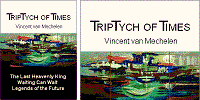
An example of the combined special usage of the prefixes in- and
aan- of Deze Taal can be found in
(The title means "So long as my grave is still empty ...".)
In this poem the word aandacht (attention) is
linked with the
nanacatena,
a visual symbol of neutralism, while the word invloed
(influence) is linked with sassafras leaves, a visual symbol of
inclusivism.
Traditionally, metric(al) is translated as metriek (with
stress on the second syllable) when referring to the system of
measurement which uses the meter as its standard, and as metrisch
(with stress on the first syllable) when referring to meter in verse.
This is still correct (as well), but in the case of the name Metric
Calendar the translation Metrisch has been chosen.
Just as in the source language, metrisch emphasizes the
substance of the metric idea, that is, the meter.
Similarly, the translation selected for
ananormative
(with primary stress on the third syllable) is ananorm (with the
same stress on the third syllable) instead of ananormatief (with
primary stress on the fifth syllable), which one might expect because
normative on its own is normatief.
The reason is that in this symbolically important word the use of
ananorm emphasizes the syllable with the core meaning, whereas the
use of ananormatief would emphasize the syllable with the least
meaning.
(Therefore, the Ananormative model should be translated as het
Ananorme model.)
In general the word wheel corresponds with both wiel and
rad.
However, the words wheel and cycle in This Language are akin
to the foreign words kyklos (meaning "ring, circle, cycle, wheel"),
telos (meaning "end, consummation, completeness") and
c(h)akra (meaning "wheel").
The word wiel belongs to the same group of cognate morphemes.
Where this etymological relatedness plays a symbolic role, directly
connecting the 'wheel of the Norm' with a telos and
teleology, the rendering of wheel cannot be but
wiel in Deze Taal.
At the moment all the terms in the tables below are from the
Model of Neutral-Inclusivity.
TRINPsite has a
special list of Model terms
with information on where they occur for the first time or are further
explained in the Model, and on how they are pronounced in This Language.
It may be of some interest that purely
catenical
terms such as
nanacatena
(evenrichtingsketen) and catenical itself (keteniek)
were first coined in Dutch (Nederlands) and translated into
English later.
In
The values of
linguistic systems, a section of
Language as Means and as
Product, a division of the
Book of Instruments,
it is clearly stated that '[w]here there are two or more options open to
us ... the most regular (or least irregular) and the most phonetic (or
least unphonetic) variant is employed, regardless of its being perhaps
traditionally more frequently used in one country or region of the world
than in another'.
This policy was applied to the first language in which the Model was
written, and it should apply to any later language in which the Model is
rewritten.
For Deze Taal it means, among other things, that the
Integratieve Spelling ought to be used.



![[TO MAIN DOCUMENT]](../../Graf/Icon/ButtonBl.gif)